Most leaders know how to push through a slow start. Fewer can tell whether the slow start is a failure to fix or a phase to wait out. The two look almost identical from the inside, and mistaking one for the other is how good initiatives die.
The agency needed four months
A founder I knew had built his business on referrals. The pipeline had been reliable for years, but referrals are unpredictable by nature, and he knew it. So he invested in an outbound program and hired an agency to build pipeline through cold outreach.
The agency was clear from the start. Outbound takes time. The first month would be list building, messaging, and early outreach. Responses would be limited. Conversions would be rare. The system needed roughly four months to find its rhythm.
Month one delivered exactly what the agency had promised. Leads were coming in. Conversations were starting. Nothing was closing. He watched the activity reports and felt the unease build. Money was going out. Revenue was not coming in. By the end of month one, he cancelled.
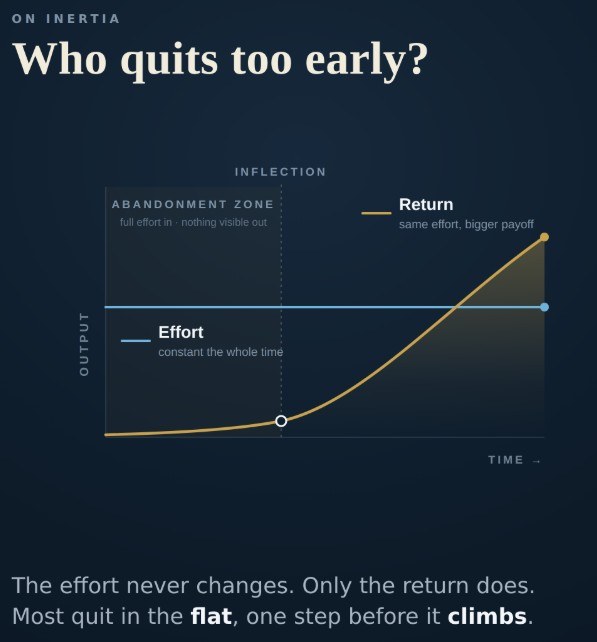
What he read as a failing program was a program in its inertial phase. The messaging was still being refined. The responsive verticals were still being found. None of that shows up in a conversion number in month one, because it never could. The pipeline problem he set out to solve is still there.
What inertia actually is
Every new effort resists movement at the start. This is not a warning sign. It is the natural state of any system that has not yet stored energy.
In the beginning, effort is consumed by setup. Trust has to be earned. Clarity has to replace assumption. Patterns have to repeat before they reinforce. The effort is real and constant, but the return arrives slowly and unevenly. That is the flat stretch of the curve: full effort in, nothing visible out.
That gap is the most dangerous place in the life of an initiative. It is where confidence erodes, direction shifts, and the flywheel gets reset. And each reset makes the next attempt harder, because the team learns that persistence is temporary and patience will not be rewarded.
Slow is not stalled
The difference between the initiatives that make it and the ones that do not is rarely superior effort. It is patience with the early phase. Leaders who understand inertia let the system absorb effort long enough for movement to begin carrying itself.
Once that happens, the experience changes. Decisions start to shorten. Escalations decrease without anyone pointing it out. Feedback improves. None of it feels like a victory in the moment. It feels like things that stopped being problems. The leaders watching for a dramatic win miss it. The ones who understand inertia recognize it and stay the course.
The challenge was never persistence through pain. It is patience with the physics of progress.